Español
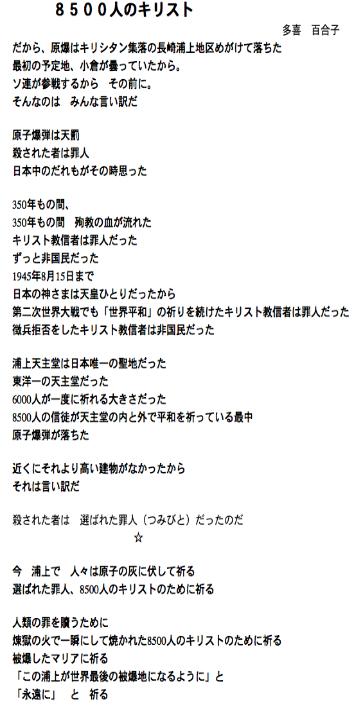
Usted ve tan,
Era el enclave cristiano,
Districto de Uragami de Nagasaki,
Sobre cuál cayó la bomba atómica.
"Vino porque Kokura, la primera blanco, fue
nublado encima."
"Vino batir la entrada de la Soviet Union en la
guerra."
No, éstos son incorrectos. Son excusas.
La bomba era castigo divino,
Y ésos matados eran criminales, sinners.
Pensó tan a japoneses del tiempo de guerra.
Por 350 años,
La sangre de martyrs había fluido.
Los believers cristianos eran todos los criminales,
Habían estado siempre los traidores.
Hasta De Agosto El 15 De 1945,
El dios de Japón estaba por ley
El y el único Emperador.
Tan los cristianos -
Rogación continuamente para la "paz del mundo"
Incluso después de WW II había comenzado -
Eran los trituradores de ley, doers malvados.
Estos believers de los cristianos,
Quién incluso rechazó servicio militar,
Eran los traidores.
Iglesia Católica De Uragami,
Lugar santo cristiano único de Japón,
Y la iglesia católica más grande del este lejano.
6000 inmediatamente podrían
Ruegue junto adentro.
8500, adentro y afuera, eran
Rogación para la paz
Cuando cayó la bomba.
“Es porque no había edificios más altos alrededor”
No, no. Otra excusa.
Los que murieron eran
Criminales, pecadores,
Escogido morir.
Oramos a ellos quién quemó instantáneamente
En ese fuego purgatorial,
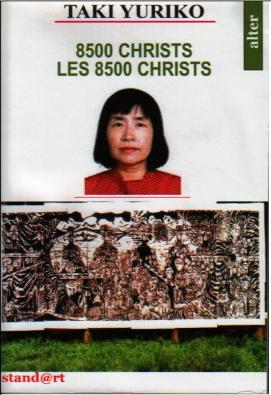
Los 8500 Cristo
Que expiaron para pecados contra la humanidad
Por sus muertes.
Oramos a una “Campana del Angel” radioactiva
Oramos a una Virgen María estallada:
“Mayo el sitio de Uragami sea la última explosión
atómica en la tierra”.
"El muy último", oramos.
Primera publicación del mundo.
Traducido a español por Sophia & Michael Dediu
****************************************
Comentarios sobre el libro “8500 Christs” de Taki Yuriko
Español
Dr. Michael Dediu – Cientifico, doctor en matematicas, poeta,
Presidente de Derc, Inc., una compañía principal de la
investigación y de consultar, y presidente de The Quiet
Enviroment Society (la Sociedad para el Ambiente Reservado).
Antes de Descartes, la poesía, y el arte en general, no
consideraban una rotura en medio adentro y afuera, el tema y el
objeto. Aristotle aparece ver una armonía entre los objetos
exteriores (forma real), los órganos del sentido, y el
pensamiento racional (forma potencial). Platón no ve una
armonía entre afuera y adentro.
Se parece que el arte oriental, como arte occidental pre-
Cartesiano, no hace una rotura radical entre el tema y el objeto.
Tsurayuki presupuso una armonía entre la emoción interna y los
objetos naturales o culturales externos. Basho escribió haiku,
una forma del verso de tres líneas y diecisiete sílabas.
Taki Yuriko escribe en un diverso estilo, más cercano a
Baudelaire, a Barbilian, a Frost, a Ana Dediu, y a Guillen.
Un análisis ad ovo del libro de Taki Yurico demuestra un
acercamiento poste-Cartesiano, revelando claramente el mensaje
que todos los conflictos fueron comenzados por los dictadores
y los militarists peccant y obstreperous, por lo tanto, volens
nolens, la solución para la humanidad es democracia, libertad y
paz con freedom.
On this site, all translations in Spanish, as well as from
Portuguese in English (for the text of Dr. Teresinka Pereira),
were provided by Sophia & Michael Dediu
En este sitio, todas las traducciones en español, así como de
portugués en inglés (para el texto del Dr. Teresinka Pereira),
fueron proporcionadas por Sophia y Michael Dediu
|
Comments on Taki Yuriko's book “8500 Christs
English
Dr. Ernesto Kahan - Poet, doctor in physician,
Vice President of the World Congress of Poets
Former vice president of IPPNW (this organization was
awarded Nobel Peace Prize in 1985).
"I strongly invite those who ask, who live as historical
individuals to read her poetry and to be part of Yuriko's
communication: history - author - pain description - reader -
emotion - question about responsibility.
Taki Yuriko's poetry is fascinating."
Robyn Ianssen - President of the XXIst World Congress of
Poets
"I recently read the work of Taki Yuriko, a present day poet
who uses Christian imagery and concepts. In her book “8500
Christs” (stand@rt, 2003) she has many moving poems about
World War II, including the Bridge Over The River Kwai,
Hiroshima and Auschwitz, and about later events such as
Chernobyl. The author says she hopes we can talk about the
most difficult problems with true intentions."
Dr Teresinka Pereira – President of International Writers and
Artists Association (IWA)
“Taki Yuriko has publications in various national and foreign
magazines and anthologies.
Her poetry is strong, presents powerful images, invoking the
great injustices of this world, like tortures, wars, and like the
religious exploitation in all the times.”
Dr. Dorin Popa - President of the XXIInd World Congress of
Poets
December 2002, Iasi
"Taki Yuriko is a person of action, she likes traveling of the
present in the past and of past in the present. Her assistances:
the memory and the readings.
In my opinion, Taki Yuriko knows very well things that really
matter, but continues to seek the most powerful way of
expressing them."
Español
Dr. Ernesto Kahan - Poeta, doctor en la literatura y el
médico, - Vice Presidente del Congreso del Mundo de Poetas
De Agosto El 6 De 2003, Israel
"Invito fuertemente a los que pidan, quién vivo como individuos
históricos para leer su poesía y ser parte de la comunicación de
Yuriko: historia - autor - descripción del dolor - lector -
emoción - pregunta sobre responsabilidad.
La poesía de Taki Yuriko es fascinadora."
Robyn Ianssen - Presidente del Congreso del Mundo de XXI de
Poetas
"Leí recientemente el trabajo de Taki Yuriko, un poeta
contemporáneo quién utilice imágenes y conceptos cristianos.
En su libro “8500 Christs’ (stand@rt, 2003) ella tiene muchos
poemas móviles sobre la Segunda Guerra Mundial, incluyendo
El Puente Sobre El Río Kwai, Hiroshima y Auschwitz, y sobre
acontecimientos más últimos tales como Chernobyl. El autor
dice que ella espera que poder hablar de los problemas más
difíciles con intenciones verdaderas."
Dr Teresinka Pereira – Presidente de la Asociación
Internacional de los Escritores y de los Artistas (IWA)
“Taki Yuriko tiene publicaciones en varios revistas y antologías
nacionales y extranjeros.
Su poesía es fuerte, presenta las imágenes de gran alcance,
invocando las grandes injusticias de este mundo, como
torturas, como guerras, y como la explotación religiosa en
todas las veces.”
Dr. Dorin Popa - Presidente del Congreso del Mundo de XXII
de Poetas
Diciembre de 2002, Iasi
"Taki Yuriko es una persona de la acción, ella tiene gusto de
viajar del presente en el pasado y del pasado en el presente. Su
ayuda: la memoria y las lecturas.
En mi opinión, Taki Yuriko sabe las cosas muy bien que
realmente importan, pero continúa buscando la manera más de
gran alcance de expresarlos."
|